Starvard University · Cars
Cars 101
A car is the second biggest purchase most people make and the easiest place to get ripped off. This course covers buying smart, financing without fear, basic maintenance, and finding a mechanic you can trust.

Starvard University
Cars 101 · Starvard University
The whole course in brief
Twelve lessons in ten points. The rest is mileage.
- Think total cost, not sticker price. Depreciation, fuel, insurance, and repairs decide what a car really costs.
- Used is usually the smart money. Let someone else eat the first three years of depreciation.
- Never negotiate monthly payments. Negotiate the out-the-door price. Payments hide the real cost.
- Arrange financing before you shop. A pre-approved loan turns you into a cash buyer at the dealership.
- Maintenance is cheaper than repairs. Oil, fluids, tires, and brakes on schedule prevent the big bills.
- Find your mechanic before you need one. Ask around, check reviews, and build the relationship early.
- Get a pre-purchase inspection. A hundred bucks to a mechanic before you buy a used car is the best insurance there is.
- The F&I office is a profit center. Decline the extended warranties and add-ons; they are priced for the dealer, not you.
- Insure the car, not the ego. High deductibles and liability limits that protect your assets.
- Drive it for ten years. The cheapest car is the one you already own, maintained well.
Lesson 1
What a Car Really Costs
The sticker price is maybe half the story. The real cost of a car over five years is depreciation (the value it loses), fuel, insurance, maintenance, repairs, and financing interest. A $30,000 car can easily cost $45,000 over five years once everything is counted. Always think in total cost of ownership.
Depreciation is the silent killer. New cars lose roughly 20 percent of their value in the first year and about half in five. That is not a flaw in your car; it is the market. Understanding this one fact changes every car decision you will ever make.
Before shopping, set a real budget: total car costs under 15 percent of your take-home pay, and never finance longer than 60 months. A 72 or 84 month loan means you owe more than the car is worth for years. That is called being upside down, and it is a trap.
Think in total cost, not sticker price. Depreciation, fuel, insurance, and repairs are the real price tag.
Lesson 2
The Test Drive: Shop Like a Pro
Test drive at least three cars, including ones you think you do not want. Comparison is how you learn what actually matters to you: visibility, seat comfort, road noise, how the car behaves at highway speed. Fifteen minutes around the block tells you almost nothing. Ask for a longer route.
Drive it like you will own it. Highway merge, tight parking, bumpy roads, night visibility. Bring your car seat if you have kids. Load your golf clubs, your dog crate, whatever your life actually involves. The car has to fit your Tuesdays, not just your imagination.
Take notes after each drive, while it is fresh. Cars blur together fast. Rate comfort, visibility, noise, and gut feeling out of ten. The notes keep the fourth test drive honest against the first, and they kill the recency bias that sells so many wrong cars.
Drive three, note everything. Comparison is the only way to know what you actually want.
Lesson 3
New vs. Used: The Depreciation Curve
Here is the math that matters: a three-year-old car has lost roughly 40 percent of its value but has 80 percent of its useful life left. Someone else paid for the steepest part of the depreciation curve, and you get a modern, reliable car for nearly half price. This is the sweet spot.
New cars make sense in exactly two cases: you found a screaming deal with incentives that erase the depreciation gap, or you plan to drive it for 12-plus years, spreading that first-year loss paper thin. Otherwise, used wins on pure economics every time.
Certified pre-owned (CPO) splits the difference: manufacturer-inspected used cars with extended warranties, at a premium over regular used. Worth it if the warranty is real and the premium is small. Read the certification checklist; "certified" means different things at different brands.
Buy the three-year-old car. Let someone else pay for the steepest depreciation.
Lesson 4
Financing Without Getting Fleeced
Get your loan before you shop. A pre-approval from your bank or credit union tells you your rate and budget, and it turns you into a cash buyer at the dealership. The finance office cannot mark up a rate you already have. Credit unions consistently offer the best auto rates.
Keep the term at 60 months or less. Longer terms mean lower payments but far more interest, and years spent owing more than the car is worth. If you need 84 months to afford the payment, you cannot afford the car. Buy cheaper.
Put at least 10 to 20 percent down. It protects you from going upside down and lowers the payment without stretching the term. And never roll negative equity from your old car into the new loan; that is how $20,000 cars become $30,000 debts.
Pre-approve first, 60 months max. The loan you arrange beats the loan they sell you.
Lesson 5
Maintenance Basics That Save Thousands
Maintenance is the cheapest money in car ownership. Follow the manufacturer's schedule in your owner's manual, not the quick-lube shop's upsell schedule. The manual was written by the people who built the car. The upsell was written by people who profit from your fear.
The big four: oil changes at the manual's interval with the specified oil, coolant and transmission fluid on schedule, air filters when dirty, and spark plugs at their interval. None of this is exotic. All of it prevents the four-figure repairs.
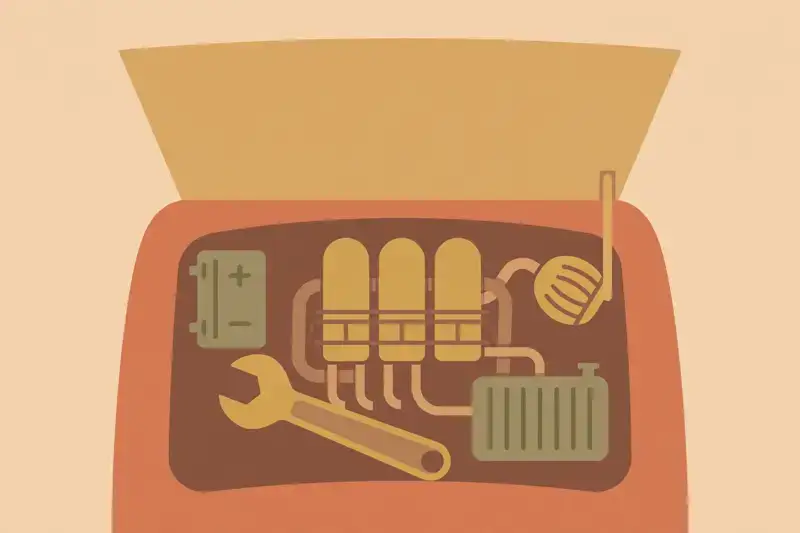
Learn to check your own oil, coolant, and tire pressure monthly. It takes ten minutes and catches problems while they are cheap. A car that is low on oil will happily destroy its own engine without complaint until the day it cannot. Your eyes are the early warning system.
The manual beats the upsell. Scheduled maintenance is the cheapest repair you will ever buy.
Lesson 6
Tires, Brakes, and Fluids
Tires are the only part of your car that touches the road. Check pressure monthly (the number is on the driver's door jamb, not the tire sidewall), rotate them per the manual, and replace them when tread wears to the wear bars. Bald tires in rain are genuinely dangerous, not just a maintenance item.
Brakes talk to you. Squealing, grinding, a pulsing pedal, or a longer stop all mean get them checked now. Brake pads are cheap; the rotors they destroy when ignored are not. Do not wait on brakes. Ever.
Fluids are the car's blood: engine oil, coolant, brake fluid, transmission fluid, power steering fluid. Each has a check interval in the manual. Dark, low, or burnt-smelling fluid is a message. Read it early and the fix is a fluid change. Read it late and the fix is a rebuild.
Listen to the car. Squeals, grinds, and dark fluids are cheap problems if you act fast.
Lesson 7
Finding an Honest Mechanic
Find your mechanic before you need one, the way you find a doctor before you are sick. Ask friends, coworkers, and neighbors who they trust. Read reviews looking for patterns, not perfection: "honest," "explained everything," and "didn't push extras" are the phrases that matter.
A good shop shows you the old parts, explains the problem in plain language, gives written estimates before work, and prioritizes repairs by safety and urgency. A bad shop pressures you, refuses to show parts, or "finds" something catastrophic every single visit.
Build the relationship with small jobs first: oil changes, inspections. Learn their name. Ask questions and listen to the answers. A mechanic who knows you are a regular treats you like one. Loyalty goes both ways in this business.
Find them before the breakdown. Trust is built on oil changes, not emergencies.
Lesson 8
Negotiating the Price
Negotiate one number: the out-the-door price, including all taxes and fees. Never negotiate the monthly payment; dealers can hit any payment by stretching the term or hiding fees, and you will pay thousands more while feeling like you won.
Do your homework before you walk in. Know the fair market value from pricing guides, know what similar cars are listed for within 100 miles, and know your walk-away number. Information is leverage. The buyer who knows the market cannot be bluffed.
Be pleasant, be patient, and be willing to leave. "I need to think about it" is the most powerful sentence in car buying. End-of-month timing helps, competing quotes help more. Email three dealers for their best out-the-door price and let them bid. The car will still be there tomorrow.
Out-the-door price or nothing. Monthly payments are where the real cost goes to hide.
Lesson 9
Surviving the Dealership
After you agree on a price, you meet the F&I (finance and insurance) manager. This is a profit center wearing a desk. They will offer extended warranties, paint protection, gap insurance, VIN etching, and fabric guard. Almost all of it is wildly overpriced. A polite "no thank you" to everything is the correct default.
Watch for the classic moves: the four-square worksheet that hides the price in payment math, the "this price is only good today" pressure, the yo-yo (they let you take the car then call you back to resign at a worse rate), and added fees that appeared from nowhere. Question every line.
Bring a checklist and a friend. The friend's job is to say "let's think about it" when your eyes glaze over. Never buy a car when you are tired, rushed, or emotional. The dealership is designed to wear you down; your defense is slowness.
"No thank you" to everything in F&I. Slowness is your armor against the upsell.
Lesson 10
Insurance: Cover What Matters
Car insurance has one job: protect you from financial ruin. That means high liability limits (100/300/100 at minimum), because one bad accident with injuries can exceed state minimums fast and come after your assets. Liability is the part that protects your future.
Raise your deductibles to lower your premiums, and keep an emergency fund to cover the deductible. A $1,000 deductible with a funded emergency account beats a $250 deductible with no savings. You are trading a small certain cost for a big uncertain one.
Drop collision and comprehensive when the car's value falls below about ten times the premium cost. Paying $800 a year to insure a $4,000 car is bad math. And shop your insurance every two years; loyalty to insurers is rarely rewarded, but quotes are free.
High liability, high deductible, shop often. Insure against ruin, self-insure the small stuff.
Lesson 11
The Pre-Purchase Inspection
Before buying any used car, pay an independent mechanic $100 to $200 for a pre-purchase inspection. They put it on a lift, check for frame damage, leaks, worn components, and hidden accident repair, and hand you a report. This is the single highest-value hundred dollars in car buying.
Sellers who refuse an inspection are telling you everything. Honest sellers welcome it. If the inspection finds issues, you have three options: walk away, negotiate the price down by the repair cost, or ask the seller to fix them first. All three beat discovering the problems yourself.
Also run the vehicle history report and check for open recalls. History reports miss things (not every accident is reported), which is exactly why the physical inspection matters more. Paper plus lift equals confidence.
Inspect before you buy, no exceptions. A hundred dollars now or thousands later.
Lesson 12
Your 5-Year Car Plan
The cheapest car is the one you already own. Plan to drive every car you buy for at least ten years or 150,000 miles. The math is brutal for flippers: transaction costs, taxes, and fresh depreciation every few years versus one paid-off car with known history.
Set up a car fund: a monthly automatic transfer for maintenance, repairs, and your next down payment. $150 to $250 a month covers most maintenance and builds the next purchase fund. When the car is paid off, keep making the "payment" to yourself.
Know when to let go: when annual repairs exceed the car's value, when rust compromises safety, or when reliability fails you repeatedly. Sentimentality has a price; pay it knowingly. Until then, maintain it well and drive it happily.
Drive it for a decade. The paid-off car you maintain is the cheapest car there is.
Graduation
Drive Smart
You know the total cost, the depreciation curve, the financing traps, the maintenance that matters, and how to negotiate like you mean it. Cars will try to take your money for the rest of your life. Now you get to keep most of it.
Back to Starvard University