Starvard University · Crypto
What cryptocurrency is, what it is not, and how not to lose your shirt. The honest guide, no hype, no shilling, no financial advice.

The whole course in brief
This course is educational, not financial advice. Nothing here tells you to buy or sell anything.
The twelve lessons
Lesson 1
Normally, a bank keeps the ledger: who has what money. A blockchain replaces the bank with a network. Thousands of independent computers each hold a copy of the same ledger, and they use math to agree on every update. No single party can rewrite history, because everyone else holds a copy.
Transactions get bundled into "blocks," each block cryptographically linked to the one before it, forming a chain. Changing an old block would mean re-doing all the math for every block after it, on most of the network's computers simultaneously. That is what makes the ledger trustworthy without a trusted middleman.
This is genuinely clever technology. It solves a real problem: how do strangers agree on ownership without trusting each other or a referee? Whether that cleverness justifies the prices of crypto assets is a completely separate question, and we will stay honest about the gap.
Lesson 2
Bitcoin was the first cryptocurrency, launched in 2009, and it remains the biggest. Its core idea is digital scarcity: there will only ever be 21 million bitcoins, enforced by code that everyone running the network agrees on. No government can print more. That fixed supply is the entire investment thesis.
New bitcoins are created by "mining," where computers compete to solve math puzzles and the winner adds the next block and earns new coins. This burns enormous electricity, which is both the security mechanism and the most valid criticism of the whole system. The cost of attacking the network is the cost of out-computing it.
Lesson 3
Ethereum took the blockchain idea and added programmability: "smart contracts," code that runs on the network and moves money automatically. This enabled tokens, lending protocols, digital art markets, and a thousand experiments. Think of Bitcoin as digital gold and Ethereum as a programmable platform people build on.
Then came thousands of other coins, most of which will go to zero. The pattern repeats every cycle: a few real projects, a wave of imitations, and a graveyard of tokens that existed to enrich their creators. The further you stray from the biggest, most established assets, the closer you get to the casino.
A useful filter: does this coin do something that needs a blockchain, or could a database do it better? Most fail this test. Blockchain is slow and expensive compared to a normal database. Its only advantage is operating without trusted parties. If trust is not the problem, blockchain is not the answer.
Lesson 4
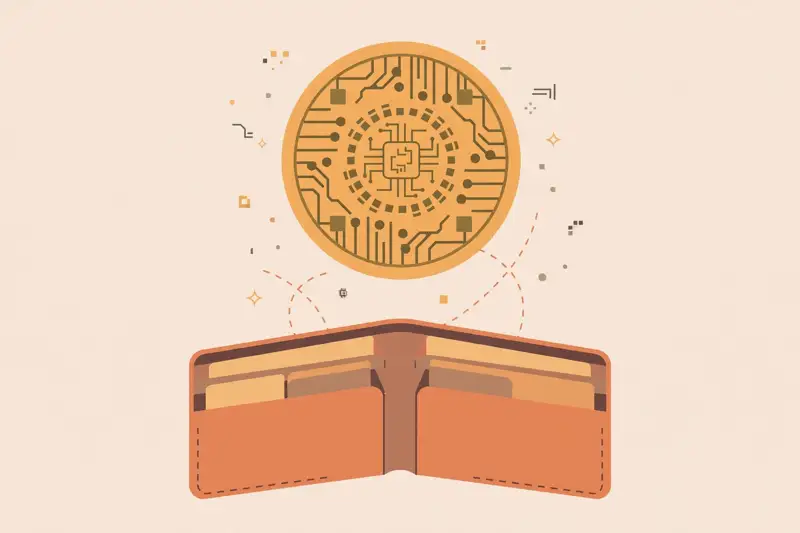
A crypto wallet is not a wallet. It is a keychain. Your coins live on the blockchain; the wallet holds the private keys that prove you own them and let you spend them. Whoever has the keys has the coins. There is no password reset, no customer service, no undo.
Keys are usually backed up as a "seed phrase," twelve or twenty-four ordinary words. Anyone with those words owns everything. Write them on paper, store copies in separate safe places, never photograph them, never type them into a website. This one habit prevents most personal crypto losses.
Hot wallets (phone apps) are convenient and hackable. Cold wallets (hardware devices kept offline) are inconvenient and far safer. Match the storage to the amount: pocket money in hot, serious money in cold. And understand the tradeoff you are making: total control means total responsibility.
Lesson 5
Exchanges are where most people buy crypto, and where most crypto disasters happen. When your coins sit on an exchange, you do not hold them. You hold an IOU from a company. If the company is hacked, goes bankrupt, or turns out to be fraudulent, your IOU is worth whatever the bankruptcy court says.
This is not theoretical. Major exchanges have collapsed and taken customer funds with them, repeatedly, in every market cycle. The industry saying exists for a reason: not your keys, not your coins. Buy on a reputable exchange, then withdraw to a wallet you control.
Lesson 6
Bitcoin has dropped 50% or more multiple times in its history, and smaller coins routinely drop 80 to 90%. These are not black swans. They are the normal weather of this market. If you cannot watch your position halve without panic-selling, your position is too big.
Volatility cuts both ways, which is why people stay. The same market that drops 50% has also posted the best returns of any asset class over the last decade. But past returns do not promise future ones, and most people buy near tops and sell near bottoms because volatility punishes emotions.
The only sane sizing rule: money you can afford to lose completely, an amount whose total loss would not change your life. For most people that is a small single-digit percentage of their investments, or zero. Both are respectable answers.
Lesson 7
More people lose money to crypto scams than to market crashes. The playbook: guaranteed returns, celebrity endorsements that are fake, "send one coin, get two back" giveaways, romance scams that pivot to "investment opportunities," and fake exchanges that let you deposit but never withdraw.
The iron rule: guaranteed returns do not exist in any market. Anyone promising them is lying, and in crypto the lie is usually the entire business. Real investments come with risk disclosures. Scams come with urgency, secrecy, and pressure to recruit your friends.
Protect yourself the boring way: never send crypto to strangers for any reason, verify every URL before connecting a wallet, assume every DM about investing is a scam, and be deeply suspicious of anyone who found you first. Legitimate opportunities do not hunt you down on social media.
Lesson 8
Stablecoins are crypto tokens designed to hold a steady value, usually one dollar. They are the boring, useful part of crypto: a way to move dollars around the world quickly, hold funds between trades, or earn yield, without the roller coaster.
The catch is trust. A stablecoin is only as good as the reserves backing it. The reputable ones publish attestations of dollar reserves. The disreputable ones, including one famous algorithmic stablecoin that collapsed and vaporized tens of billions, were backed by hope and math that did not hold. Stick to the boring, audited ones.

Lesson 9
DeFi, decentralized finance, rebuilds lending, trading, and earning interest as smart contracts with no bank. The yields advertised are real sometimes and spectacular, which should tell you the risk is spectacular too. Smart contracts have bugs, and bugs in money code get exploited within hours.
NFTs proved that blockchains can certify ownership of digital items, then spent two years proving that most digital items were not worth owning. The underlying idea, verifiable digital ownership, may matter someday for tickets, identity, and gaming. The speculative mania mostly did not.
Treat both as experiments you watch, not investments you need. If you participate, use amounts you would spend on entertainment, because entertainment is what it is.
Lesson 10
In most countries, crypto is taxed like property, not currency. Every sale, every trade of one coin for another, and often every purchase made with crypto is a taxable event. Trading Bitcoin for Ethereum is two taxable events. The exchange will not do this math for you.
Track everything from day one: dates, amounts, values in your local currency. There are tools that import exchange history and compute it, and they are worth every penny at tax time. The people who get hurt are the ones who traded actively for a year and kept no records.
When in doubt, talk to a tax professional who knows crypto. The rules keep evolving, the penalties for getting it wrong are real, and an hour of professional advice is cheap compared to an audit.
Lesson 11
Let us be blunt. Crypto's bull case: a scarce digital asset class keeps growing as adoption spreads, and early-ish participants are rewarded for the risk. Crypto's bear case: prices are mostly speculation, regulation could bite hard, and most coins go to zero. Both cases have evidence. Nobody knows which wins.
What is certain: the volatility is real, the scams are everywhere, and the technology does not need you to get rich for it to be interesting. You can find blockchains fascinating and still keep your money in index funds. Those positions are compatible.
The people who do worst in crypto share traits: they invest money they need, they chase whatever is pumping, they trust strangers with their keys, and they confuse a bull market with personal genius. Avoid those four and you have avoided most of the damage.
Lesson 12
If, after all that honesty, you still want exposure, here is the least-dumb way. Small size: money you can lose completely. Major assets only: the established coins with a decade of survival, not the trending token. Long horizon: years, not weeks, because timing this market is a losing game.
Buy on a reputable exchange, withdraw to your own wallet, back up the seed phrase on paper in two places, and then mostly leave it alone. No leverage, no day trading, no chasing pumps. Boring is the strategy. The exciting strategies are how exchanges make money off you.
Revisit once a year, rebalance if it grew into an uncomfortable share of your money, and keep living your life. Crypto should be a footnote in a solid financial plan, never the plan itself.
Graduation
You now understand the technology, the assets, the risks, and the scams better than most people with money in the market. That knowledge is the real asset. Whether you participate or watch from the sidelines, you will do it with open eyes, which puts you ahead of the crowd either way.
Keep learning
This course is part of Starvard University, striving for greatness.