Starvard University · French
French opens a continent: France, Belgium, Switzerland, Quebec, and much of Africa. This course gets you conversational: pronunciation, the verbs that matter, and real practice from day one.

The whole course in brief
Twelve lessons in ten points. The rest is practice.
The twelve lessons
Lesson 1
French is the most useful second language in Europe and far beyond. It is an official language in 29 countries, the working language of diplomacy, and the key to France, Belgium, Switzerland, Quebec, and French-speaking Africa. Wherever you travel, French opens doors.
For English speakers, French shares thousands of cognates: nearly a third of English vocabulary came from French. Words like "information," "possible," and "table" need no translation. You already know more French than you think.
Set your goal clearly: conversational fluency, the ability to hold a real conversation about real things. Not perfection, not literature. Conversation. Every lesson in this course points at that target.
Lesson 2
In France, "bonjour" is not just a greeting; it is a social requirement. You say it entering every shop, to every cashier, before anything else. Skipping it reads as rude. "Bonjour" first, then your request. This one word buys more goodwill than any grammar ever will.
Your starter set: bonjour (hello), merci (thank you), s'il vous plaît (please), excusez-moi (excuse me), oui/non (yes/no), au revoir (goodbye). Add the question words: qui, quoi, où, quand, pourquoi, comment, combien. These handle an astonishing range of real situations.
Learn the tu/vous distinction early. "Vous" is the polite form for strangers, elders, and professional settings; "tu" is for friends, family, and children. When in doubt, use "vous." Being too formal is forgiven; being too familiar is not.
Lesson 3
French spelling looks nothing like it sounds, but the patterns are reliable. Silent final consonants (parlent sounds like "parl"), the nasal vowels (bon, vin, vent), and the famous French R (gargled gently in the throat) are the big three to master.
The nasal vowels have no English equivalent: air flows through both mouth and nose. "Bon" is not "bone." Listen to native speakers and imitate shamelessly, exaggerating at first. Your mouth needs new muscle memory, and exaggeration builds it fastest.
Liaisons are the secret rhythm of French: final consonants link to following vowels (les‿amis, pronounced "lay-zah-mee"). This linking is what makes French sound like flowing music instead of chopped words. Start linking early and you will sound French long before you are fluent.
Lesson 4
Être (to be) and avoir (to have) are the two most important verbs in French. They appear everywhere, and together they build the passé composé, the main past tense. Memorize their present tense forms cold: je suis, tu es, il est; j'ai, tu as, il a.
These verbs are irregular, which means no pattern will save you: only repetition. Drill them in sentences, not in tables. "Je suis fatigué" (I am tired), "j'ai faim" (I am hungry, literally "I have hunger"). Sentences stick; conjugation tables evaporate.
Note the beautiful logic: French expresses many states with "avoir" where English uses "to be." Hunger, thirst, age: j'ai faim, j'ai soif, j'ai trente ans. You do not "are" thirty; you "have" thirty years. Learn the logic and dozens of phrases come free.
Lesson 5
Reading is the beginner's superpower in French. Because of the shared vocabulary, you can read real French far earlier than you can understand spoken French. Start with children's books, simple news sites for learners, and menus: concrete, visual, forgiving.
Read with a system: first pass for gist, second pass looking up only the words that block meaning, third pass reading smoothly. Looking up every word kills the flow and the joy. Tolerate ambiguity; your brain fills gaps with exposure.
Keep a phrase notebook, not a word list. "Il pleut des cordes" (it's raining cats and dogs) is worth ten isolated vocabulary words. Phrases carry grammar, context, and culture in one memorable chunk.
Lesson 6
Every French noun is masculine or feminine, and adjectives and articles match: "le petit café," "la petite table." Like Spanish, there is no logic to memorize; gender is simply a property of each word.
The same trick works: always learn nouns with their article. Not "café" but "le café." Not "table" but "la table." After enough repetitions, the right article sounds right and the wrong one sounds wrong. That instinct is fluency forming.
Endings give hints: nouns ending in -tion, -sion, and -té are usually feminine; most others ending in consonants lean masculine. Hints, not rules. When in doubt, learn the chunk: article plus noun, always together.
Lesson 7
French verbs come in three families (-er, -ir, -re), and the -er family covers the vast majority of verbs you will use. Learn the pattern once (je parle, tu parles, il parle, nous parlons, vous parlez, ils parlent) and hundreds of verbs open up.
Start with the workhorses: être, avoir, faire (to do/make), aller (to go), vouloir (to want), pouvoir (can). These six verbs do a huge share of all daily communication. "Je veux aller" (I want to go), "je peux faire" (I can do): simple combinations, endless mileage.
Aller plus infinitive builds the near future: "je vais manger" (I am going to eat). This one construction lets beginners talk about the future with zero new conjugations. It is the highest-value grammar in the language.
Lesson 8
Travel is where French pays off fastest, and travel situations are wonderfully predictable. Learn the script for each: at the hotel ("j'ai une réservation"), in the taxi ("à la gare, s'il vous plaît"), at the restaurant ("l'addition, s'il vous plaît").
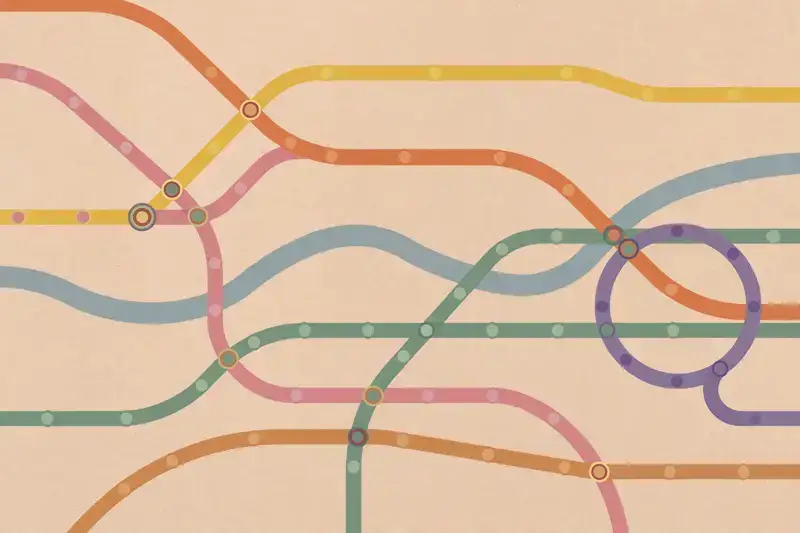
The metro is your classroom. "Où est la station...?" "C'est direct?" "Je dois changer?" Station names, direction signs, and ticket machines are free reading practice, and asking for directions starts conversations with locals who appreciate the effort.
Prepare the ten phrases before each outing, then go use them. Ordering a coffee in French at a Paris café is a rite of passage: "un café crème, s'il vous plaît." Say it like you mean it. The barista will know you are learning, and most will be delighted.
Lesson 9
The passé composé handles most past conversation, and it is beautifully mechanical: present tense of avoir (or être) plus the past participle. "J'ai mangé" (I ate), "nous avons vu" (we saw). Learn the helper verbs you already know, add participles, and you can tell stories.
Most participles are regular: -er verbs take -é (parlé), -ir verbs take -i (fini), -re verbs take -u (vendu). A short list of irregulars (fait, dit, écrit, vu, pris) covers the rest of daily life. Memorize the irregulars as chunks.
A small set of verbs uses être instead of avoir (mostly verbs of motion: aller, venir, partir, arriver). The mnemonic is a little house diagram of coming and going, taught in every French class on earth. Learn it once; it never changes.
Lesson 10
Spoken French is the hard part: liaisons blur word boundaries and native speed is relentless. Start with learner content: slow French news, beginner podcasts, children's shows. Understanding most of something easy beats understanding none of something hard.
Use the scaffolding trick: watch a film you know by heart, dubbed in French with French subtitles. Your brain knows the story, so it can focus on matching sounds to meaning. Ears are trained by hours of this, not by willpower.
French music is a gift to learners: chanson, pop, and rap all reward lyric-reading. Learn the words to songs you love and sing along. Rhythm and repetition fix pronunciation in muscle memory, and every understood lyric is motivation fuel.
Lesson 11
French culture rewards the curious far beyond clichés. The café is a way of life: coffee is never rushed, the terrace is a theater, and lingering is the point. Understanding this changes how you experience the language: French is savored, not consumed.
Find your media diet: a French series to follow, musicians to love, films to rewatch. France has one of the world's great cinema traditions, and watching films in French with French subtitles is both pleasure and study. The two are not supposed to be separate.
Learn the social choreography: la bise (the cheek kiss), the sacred lunch hour, the art of debate as friendly sport. Language is behavior as much as vocabulary. The culture makes you not just understood, but welcomed.
Lesson 12
Days 1-30: sounds and survival. Master the key pronunciation patterns, your first 100 words and phrases, être and avoir cold, and the tu/vous rules. Speak out loud daily. Days 31-60: conversations. Weekly speaking practice, present tense of the workhorse verbs, listening 20 minutes daily, first real-world outings.
Days 61-90: momentum. Passé composé for storytelling, a French film with subtitles, a growing phrase notebook, and one brave step: a full conversation with a native speaker. At day 90 you will not be fluent, but you will be conversational.
The plan after the plan: keep going. Twenty minutes a day for a year takes most learners to solid conversational fluency. The learners who quit are not less talented; they just stopped. Do not stop.
Graduation
Speak without fear. You know the sounds, the pillars être and avoir, the phrases that open doors, and the plan that builds fluency. A continent of conversation is waiting. Commencez.
Keep learning
This course is part of Starvard University, striving for greatness.